Torque wrench calibration. Not a very exciting topic for most people! However, I thought it might be useful for someone else to see how I did it using stuff I have in my garage and home. I use a clicker torque wrench which was about £20 from screwfix.
Why calibrate a torque wrench?
How accurate does a wrench need to be? My Civic quotes the wheel nut torque as being 108Nm, without any qualification of tolerance. My MX5's manual says 88-118 Nm, which is a lenient tolerance (although I would not like to have one nut at 88Nm and one at 118Nm on the same wheel). The wrench will have been adjusted by the manufacturer to be nominally within +/- 4% accuracy when it is made. Some are specified as +/- 3%. However, over time, the wrench may drift, or may be put out of calibration if you drop it or otherwise abuse it (for example by loosening the torque setting below the minimum value). If you've no idea how accurate it is, then you might be over-tightening or under-tightening bolts and nuts outside of even lenient tolerances.
Theory of calibration
The calibration is pretty simple in theory. Torque is the product of the force being applied, times the length of the lever applying that force. So, if you are pushing on a wrench with a force of 20Kg and the wrench is 0.5 metres long, the nut you are tightening is experience a torque, or twisting force, of 10 KgM.
There are various units for torque, but they all mean the same thing and can be inter-converted. The force component may be measured in Kilograms, Newtons, or Pounds. Kilograms are a unit of mass, rather than force, but here they mean the weight of Kilograms on Earth. The distance component may be measured in Metres, Feet or Inches.
Here, I'll be using Kilograms and Metres, and converting that to Newton Metres (Nm).
The idea of the calibration is to;
- fix the square drive of the wrench into something which won't budge such that only the drive is in contact with anything
- set the wrench to measure a set amount of torque
- position the wrench exactly level horizontally
- hang a known weight off the wrench such that the weight is freely hanging by a thinnish wire, twine or cable
- keep adjusting the position of the weight until when we gently release the weight, the wrench just clicks (To be consistent, I aimed for the wrench clicking a couple of seconds after I released the weight as gently as possible).
- measure the distance from the centre of the square drive to the hanging weight
- work out the actual torque which made the wrench click
- compare it to the setting, to work out a correction factor which needs to be applied to that setting
- repeat the process for various settings across the range of the wrench, starting with the lowest and working to the highest
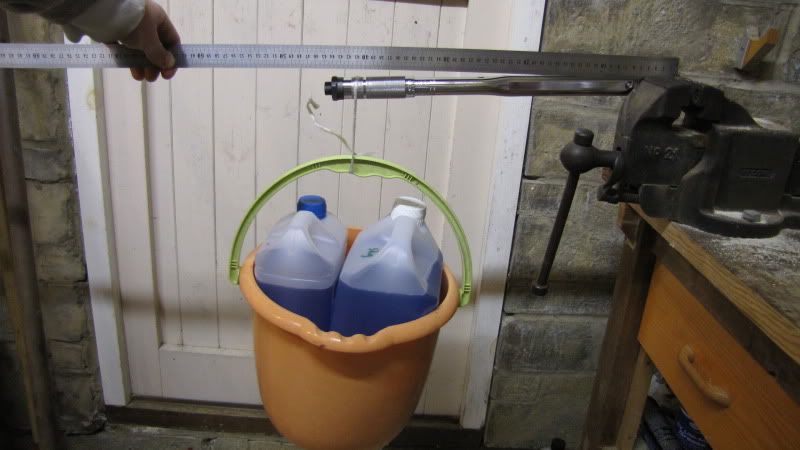
How to allow for the unweighted wrench's torque.
There is one bit missing from this. The wrench's own weight, when in the horizontal position, is already exerting some torque before we hang the weight. We need to take that into account. It is significant, especially at the lower torque settings.
The wrench in this position is exerting its weight at the centre of mass, or balance point in this case, of the wrench. This is not exactly right, as there is a very small amount of wrench (and hence weight) to the other side of the drive away from the handle, but it is certainly better than making no allowance for the wrench's torque on its own.
So, we first of all need to measure the weight of the wrench and determine its balance point (using a thin piece of wood held in a vice for example).
For my wrench, it weighed 1.311kg and its balance point was 20cm away from the centre of the square drive. This means that the wrench alone, in the horizontal position, is exerting a torque of 1.311kg times 0.2m. You then multiply that by 9.81 to convert to Nm, which gives 2.57Nm. We just add this torque to the torque due to the weights we add to the wrench below in our calculations.


Immobilising the wrench drive
My solution was to clamp it as hard as possible in a bench vice You need to make sure even as you apply the maximum torque you intend to measure, that the vice clamps the drive securely, otherwise your measurements will be inaccurate.
Levelling the wrench
You need to ensure, using a bubble spirit level, that the wrench is level at the position before the click. It may be that your bench is not level, or that the ratchet positions on the wrench do not allow you to select one which is level. This happened to me.

You have a few options;
- Adjust the vice's bench level (e.g. by placing blocks of wood underneath the feet of the vice's bench until the wrench is level. This was my solution)
- place the drive of the wrench in some other tool which is secured in the vice, but which can be adjusted to level the wrench. I was not able to find anything which did not move under the higher torque settings
- Use something other than a vice to place the square drive into or onto (for example, a bolt on a fence post).
- If none of this works, you are not lost, as long as the angle is not so large that it causes the weight to slip along the wrench. If you can measure the angle of the wrench, then you can apply the cosine function to measure the effective force reduction being applied at that angle. See
http://www.grc.nasa.gov/WWW/K-12/airplane/torque.html.
Weights required.
I underestimated this, and it is a good idea to work this out before you do much else. My wrench is 43cm (0.43m) from the centre of the drive to the end of the wrench. This is then the maximum distance I can hang a weight. It is marked as measuring from 28Nm to 200Nm.
So, if I want to check one of the higher torque settings, say 200Nm, how much weight would I need? The answer is 200/0.43 = 465Newtons force, which you divide by 9.81 to convert to kilograms to give 47kg. That's a very heavy weight, which isn't really practical to try to hang off a torque wrench.
For the higher settings, another solution is to extend the length of the wrench, perhaps by fitting a long strong steel or iron pipe over the wrench (and fixing it in place so it doesn't move around). You can then use a smaller weight further away. This approach definitely would require working out the torque due to the unweighted wrench/pipe combination using the approach described above. In my case, I decided that the maximum torque I would measure would be 112Nm, which requires around 26kg, since I've never used a higher setting than this anyway.
You need a range of weights. You might be thinking that you could just use the heaviest weight you'll need, and have it really close to the drive for the lower torque settings. In theory, yes, in practice, no. There are two problems. Pragmatically, you won't be able to move the weight that close to the drive without having the weight touching the vice, the bench, etc. The weight needs to hang freely to be a valid measurement. Also, you want the distances measured to be near the end of the wrench. This is because the measurement error is less significant when you're working out the “just clicking” point at 40cm than it is when you are trying to work it out at say 20cm.
Unless you're lucky enough to have a set of calibrated weights from around 5kg to 30kg, you'll need to improvise. I used 5 litre containers of screenwash, a bucket of sand, a car wheel and tyre and then two smaller wheels and tyres lashed together for the largest weight. To actually weigh these objects, I used a kitchen scales for the smaller weights (up to 5.5kg individually, but since I could stick various weighed things in a bucket, this gave me usable weights up to 15kg) and a bathroom scales for the larger ones. The kitchen scales I checked the calibration of using some old imperial balance weights I had lying around.


Admittedly I only checked the calibration at one point, around 600g – I should have also checked it at the higher weights, but I'd no easy way to do this. The bathroom scales I checked also at one point using a composite of items I'd weighed from the kitchen balance to a total of 12.1kg. The point here is that there is little point in checking the calibration of the wrench if you've no idea how accurate the tools are which you are using to do this calibration. If you don't have balance weights lying around, a good solution is tap water. This weighs 1kg per litre, but this approach requires you to have a fairly accurate way of measuring out a volume of water.
Results and calculations
So, after you've skinned your knuckles, sworn a bit and finally got the hang of it, you'll end up with a series of measurements like this;
Setting: 28Nm, Weight used: 10.094kg, Distance measured: 27.2cm
Setting: 42Nm, Weight used: 10.094kg, Distance measured: 38.5cm
etc.
If we take the first measurement for 28Nm, 10.094Kg at a distance of 0.272m gives us a torque due to the weight of 26.93Nm (multiply the two and then divide by 9.81). When we add on the torque due to the unweighted wrench (2.57Nm as worked out above), we get a total measured torque of 29.51Nm. This means that at this setting the wrench is underestimating the torque being measured, and we need to apply a correction factor of 94.9% to any value we want to measure.
If we apply the same calculation to all the settings I measured, we get a table like this;
| Setting (Nm) | Weight (kg) | Distance (cm) | Weight Torque (Nm) | Actual Torque (Nm) | Correction Factor |
28 | 10.094 | 27.2 | 26.93 | 29.51 | 94.90% |
42 | 10.094 | 38.5 | 38.12 | 40.7 | 103.20% |
56 | 12.53 | 41.3 | 50.75 | 53.32 | 105.02% |
70 | 18.2 | 36.2 | 64.63 | 67.2 | 104.16% |
84 | 18.57 | 42 | 76.5 | 79.07 | 106.24% |
98 | 29 | 32.9 | 93.6 | 96.17 | 101.90% |
112 | 29 | 37.1 | 105.55 | 108.12 | 103.59% |
I then printed this out and stored it in the case with the tool. Since my Civic's wheels are spec'd at 108Nm, the closest measurement was 112Nm, so I select that and apply its correction factor. This means from now on, rather than dial up 108Nm, I'll dial 111.9Nm (basically 112Nm), in the knowledge that I'm applying the right torque. Alternatively, since the values are not within +/- 4%, but are still not too bad, I can just stop worrying about it. I've read about other people's calibrations giving them correction factors of 150%.
Post-script: I could have made three improvements to the calibration. The first would have been also to check the angle of rotation of the wrench in the vice. In extremis, if the wrench were clamped into the top of the vice, rather than the side, hanging a weight from the wrench would not exert torque on the wrench in the plane it is designed to measure.
The second would have been to calibrate the kitchen scales using a series of small weights added together. For example, I knew that the scales could weigh accurately in the 500-600g region. Therefore, I could have weighed out 10 approx 500g objects and put them together to check the scales at 5kg. I could have then weighed out 5 5kg objects to check the bathroom scales at 25kg.
The final improvement would have been to measure the balance point of the wrench at the various settings I wanted to calibrate. The dial for changing the torque setting changes the length of the wrench slightly, and hence its balance point.


